

Ruth Garside, Becca, and Kerryn Husk, with Georgie Sowman and Edward Chapman, co-authored a BMJ editorial for the Christmas edition of the journal. The editorial dicussed the evidence and investment that are needed to ensure green social prescribing supports health and aids nature recovery. We argue that in additon to being used to benefit the […]
The major challenges that society faces, such as noncommunicable diseases and climate change, require large-scale interventions that work in complex systems. These interventions are often at regional or national level scales and can rarely be evaluated using experimental methods as researchers typically can’t control who receives the intervention. Nevertheless, evaluation of these types of interventions […]

Alex has worked with BBC Studios Natural History Unit and Audible to create a new podcast focusing on the healing power of nature. You can read more about Alex’s work on his Virtual Nature project site. In today’s fast-paced world, most people are familiar with feeling stressed, anxious, and overwhelmed. But a remarkable resource exists […]
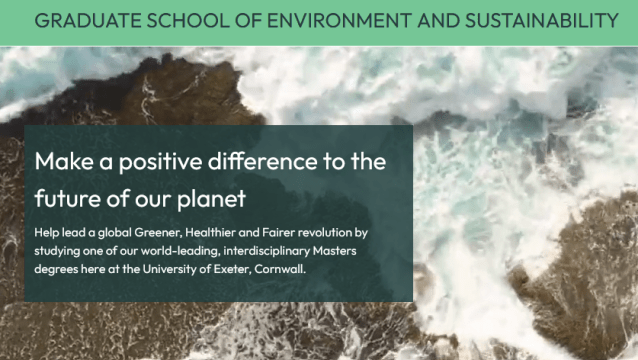
The University of Exeter has launched a new Graduate School of Environment and Sustainability that brings together experts from across the spectrum of earth and life sciences, engineering,humanities, social sciences and business working predominantly on the Penryn Campus. Each of the programmes are designed with a focus on developing solutions to global challenges and creating […]
This CPD course focuses on how natural environments can benefit the physical and mental health of humans in a variety of different ways and how this topic has become increasingly important in policy. About the course This course will explore how natural environments can benefit the physical and mental health of people in a variety […]

As part of our work for theme one of the RENEW project, the Renewing Biodiversity Longitudinal Survey, or ReBLS for short, has been launched. The aim of the longitudinal panel survey is to understand how biodiversity renewal impacts people’s attitudes towards nature and renewal efforts, nature-related behaviours, health, and well-being, and how this may change […]

The first paper from the Resonate project has been published. The paper details a new ‘nature-based biopsychosocial resilience theory’ (NBRT), which describes the ways in which nature based solutions, including green social prescribing, can help individuals and communities cope better with climate change and other environmental, social or personal stressors by enhancing social-ecological resilience. White, […]

There is growing evidence that living near or spending time in green and natural spaces is asociated with better health and well-being. However, most of this evidence is cross sectional, which represents a snapshot of people’s lives and cannot account for within person variation. This leaves open the possibility of reverse causality, where individuals with […]
Join this brand new in-person CPD course led by Ruth Garside! Ruth and her colleagues have extensive experience of producing evidence-based synthesis and providing training for a range of policy customers including NICE, NHSE, DHSC, WHO, and UN’s Green Climate Fund. In addition to understanding “what works”, policy makers and practitioners often need to understand […]
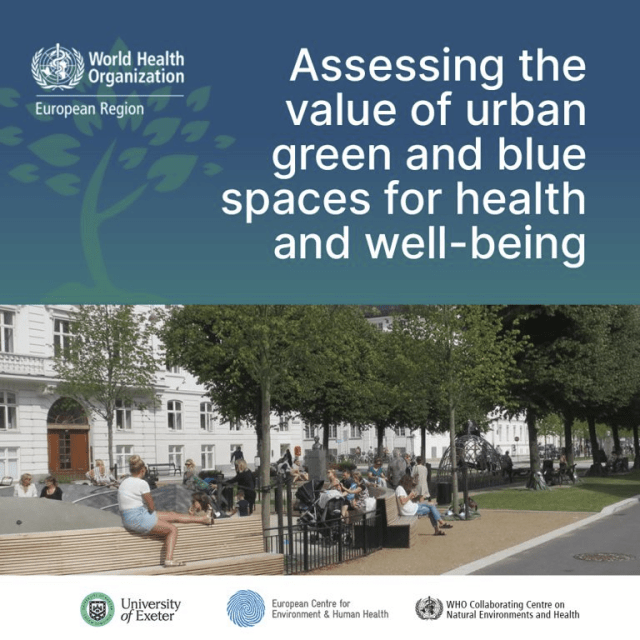
The European Centre for Environment and Human Health (ECEHH) has just been re-designated as the Collaborating Centre on Natural Environments and Health by the World Health Organization (WHO) Regional Office for Europe for a further four years! ECEHH has authored several reports for the WHO via the Collaborating Center. These include providing an overview of […]
 Beyond Greenspace