
Sarah and Lewis have collaborated on new research which explored the ways in which people with mental illnesses such as schizophrenia or bipolar use bluespaces including coastals and inland waters, and how it affects their mental health. The paper was published in the journal People and Nature.

Semi-structured online and telephone interviews were carried out with nineteen adults who self-reported experience of bipolar, schizophrenia or other psychotic conditions.
The plain language summary details how the research team included researchers, students and people with lived experience of mental ill health.
The team found that people described the idea of a ‘blue reset’, with visits to and time in helping manage mental health, countering ‘feelings of poor wellbeing’.

Bluespaces were used to find respite from the pressures of everyday life, and as a tool to help people feel better, remembering how it had helped in the past.
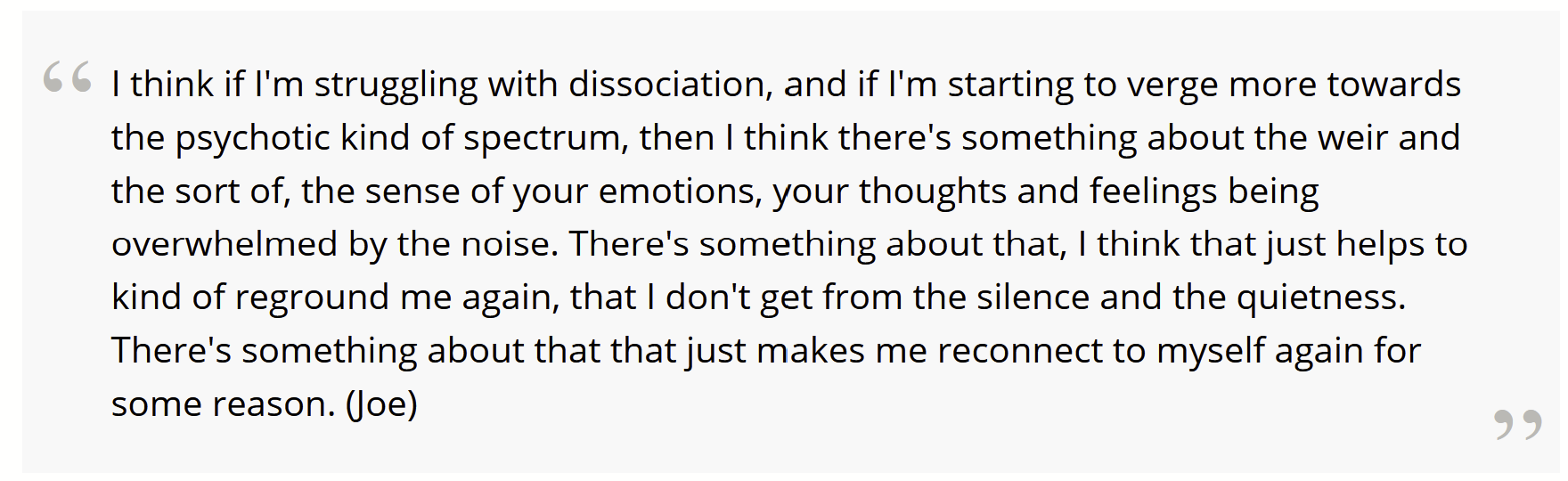
The potential of bluespaces as a setting for therpeutic interventions was also discussed. The team found that “engaging with blue space was seen as an integral part of their ongoing self-care and self-management. A number of participants considered blue space in relation to medication: some viewed blue space as preferable to medication and, for them, almost like a medication in its own right. Others found blue space visits to complement medication rather than to represent an alternative“. However the challenges of using such spaces was also highlighted. Issues such as availability and cost of transport, time constraints and mobility, weather conditions, land ownership and pollution were raised. The importance of spaces close to home was ‘a recurring feature across the interviews‘.
Wright, K., Eden, S., Hancox, A., Windget, D., Elliott, L., Glossop, Z., … & Bell, S. L. (2024). A qualitative exploration of the contribution of blue space to well‐being in the lives of people with severe mental illness. People and Nature. https://doi.org/10.1002/pan3.10620
 Beyond Greenspace